According to recently released data, Viet Nam’s total agro-forestry-fishery export turnover in the first six months of 2025 reached approximately USD 33.84 billion, up 15.5% compared with the same period in 2024. Of this, agricultural products accounted for USD 18.46 billion (up 17.8%), livestock products USD 264.4 million (up 10.1%), seafood USD 5.16 billion (up 16.9%), and forestry products USD 8.82 billion (up 9.3%). In terms of market structure, Asia remains the largest consumption region, taking 42% of total export value; the Americas account for 23.5%, and Europe about 15.6%.
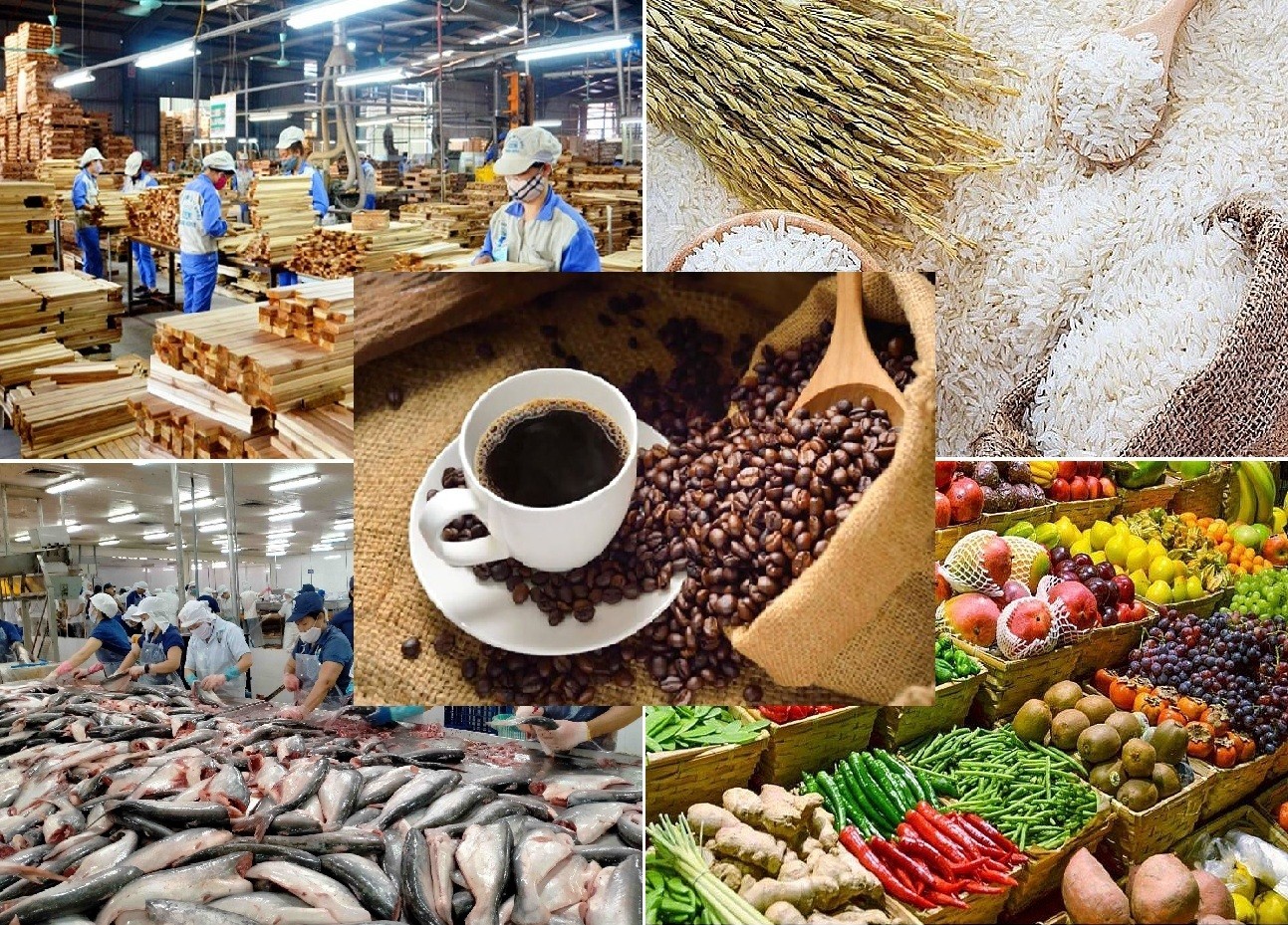
Looking specifically at the group of core agricultural commodities comprising seven key items (tea, rice, pepper, cashew nuts, fruit and vegetables, rubber and coffee), export turnover in the first half of 2025 reached around USD 14.03 billion, an increase of 17.3% over the same period in 2024. Five out of seven commodities recorded positive growth, while rice and fruit-and-vegetable products posted negative growth – reflecting a differentiated picture across product segments under the combined impact of world prices, supply–demand conditions and new technical barriers.
Export developments by commodity: Price dynamics, supply–demand and market risks
Coffee: “Overheating” growth driven by prices, facing pressure for correction
Coffee is the most impressive performer among major agricultural commodities. In the first six months of 2025, coffee export turnover reached nearly USD 4.9 billion, up 74.3% year-on-year. However, this surge is driven primarily by prices rather than volumes. The average export price over the six-month period is estimated at USD 5,708.3 per tonne, an increase of as much as 59.1% compared to the same period of 2024. Notably, coffee prices rose sharply right in the peak harvest season – a pattern that runs counter to the usual trend of previous years.
The main reason lies in extreme weather and drought in several major producing countries, particularly Brazil, which have reduced output and exerted downward pressure on supply in the Arabica coffee market. In the short term, the high-price trend is likely to persist as climate-related risks remain significant.
That said, the medium-term outlook for Vietnamese coffee is not entirely “paved with roses”. The US policy of higher tariffs is creating a new layer of risk. Many US importers are demanding that suppliers absorb the additional tariff costs, while refusing corresponding increases in purchase prices, thereby squeezing exporters’ profit margins. This factor may cause the current coffee price rally to stall or even reverse if companies fail to establish a new balance in contract negotiations and in the sharing of cost burdens.
Cashew nuts: Stable growth backed by deep processing and quality standards
After coffee, cashew nuts are among the commodities registering double-digit growth. Cashew export turnover in the first half of 2025 is estimated at almost USD 2 billion, up 16.8% year-on-year. Although the growth rate is less “explosive” than that of coffee, it is more sustainable as it rests on both price and volume.
Raw cashew prices on the world market are currently trending downward in the short term, while demand usually rises towards the end of the year (peak consumption season in the US, EU and the Middle East). This combination creates a “window of opportunity” for Viet Nam’s cashew industry to further consolidate its position. The key competitive edge lies in advanced deep-processing technology, the ability to grade, roast, flavour and package products in a wide variety of formats, and in particular the capacity to meet stringent food safety standards in demanding markets such as the United States, where cashews are highly valued for their nutritional benefits. African countries, though endowed with abundant raw cashew resources and lower production costs, still face short-term bottlenecks in deep processing and quality control, leaving room for Vietnamese firms to move ahead.
Rubber: Benefiting from tighter global supply and recovering demand
Exports of natural rubber (excluding rubber products) from Viet Nam in the first half of 2025 reached around USD 1.26 billion, up 19.3% from the same period in 2024. The outlook for 2025 appears favourable, supported by two main drivers: constrained global supply and recovering demand in key markets.
Data from the Association of Natural Rubber Producing Countries (ANRPC) show that rubber output in major producing countries in Southeast Asia has trended downward in recent years. Thailand and Indonesia – Viet Nam’s direct competitors – have witnessed significant declines in production and exports due to prolonged heavy rains, disease outbreaks and reductions in planted area. Tight supply is a key factor keeping rubber prices elevated in the near term.
On the demand side, China – Viet Nam’s largest rubber export market – is showing signs of recovery in industrial production, particularly in the automotive and tyre sectors. At the same time, the United States is expected to increase its rubber imports as domestic auto production improves on the back of higher tariffs on finished vehicle imports and a strategy to diversify rubber sources away from Canada, Mexico and China. This could generate a new wave of demand for Viet Nam’s rubber exports, provided that producers can seize the opportunity created by shifting orders.
Pepper: High prices support turnover, but US tariff pressure is emerging
By the end of the first half of 2025, Viet Nam’s pepper exports reached around USD 715 million, representing growth of 31.2% compared with the same period in 2024. This strong performance is mainly due to elevated world pepper prices amid constrained supplies after harvest and rising demand from major markets such as the Middle East and Europe in the second quarter.
However, prospects for the remaining months are increasingly overshadowed by mounting pressure from the United States – Viet Nam’s largest pepper buyer. The additional 10% tariff that the US is applying (with the possibility of an increase to 20% after 1 August) is eroding profit margins. In fact, after six months, Viet Nam’s pepper exports to the US have already begun to edge down year-on-year. Should the tariff be raised to 20% and maintained for an extended period, mid-range, price-sensitive pepper segments would be highly vulnerable to losing market share to suppliers enjoying tariff preferences or lower cost structures.
Rice: Entering a correction phase after a “peak” year
In contrast to the above commodities, rice is entering a phase of adjustment in both volume and value. In the first six months of 2025, rice export turnover amounted to approximately USD 2.2 billion, down 15.0% compared with the same period in 2024. The pressure comes from two directions: intensified competition and weaker demand in some markets.
A key factor is that India – the world’s leading rice exporter – has relaxed restrictions on rice exports, unleashing large volumes of Indian rice onto the global market and pushing world prices into a downward trend. In 2024, Vietnamese rice benefited substantially from a global supply shortfall and soaring prices, helping to set a record export value of USD 5.7 billion. In 2025, as supply normalises, the likelihood of rice prices returning to a sharp upward trajectory is low. Under these conditions, repeating the 2024 record is widely viewed as difficult.
This situation requires the rice sector to move from a strategy of “price-based windfall gains” to one of “quality-based gains”: developing premium segments such as specialty rice, fragrant rice, organic rice and low-emission rice; and, at the same time, restructuring export markets to avoid excessive reliance on highly price-sensitive segments.
Fruit and vegetables: A “weak spot” due to technical barriers on durian
Viet Nam’s fruit and vegetable exports in the first half of 2025 reached around USD 2.9 billion, down 9.3% from the same period in 2024. The main cause is a sharp decline in exports of durian – the flagship product of the sector – tied to developments in China, which accounts for an overwhelming share of demand.
From the beginning of 2025, China has required all imported durian consignments to provide laboratory analysis results on cadmium residues and the industrial dye “Auramine O”, conducted by testing facilities recognised by Chinese authorities. This requirement applies to all exporting countries, not only Viet Nam, but has a particularly strong impact because it makes export procedures more complex, lengthens customs clearance times and pushes up compliance costs. Many farmers, cooperatives and enterprises are currently struggling to meet the new cadmium residue standards, which hampers not only fresh durian exports but also frozen and processed durian products, and dissuades many businesses from expanding or even entering the market.
In 2024, durian exports reached about USD 3.4 billion, accounting for nearly 50% of total fruit and vegetable export turnover (over USD 7.15 billion). This illustrates the very high dependence of the fruit and vegetable sector’s growth on a single product and a single market. When this “key link” encounters difficulties, the entire fruit and vegetable export chain immediately suffers knock-on effects.
Outlook and risks: From retaliatory tariffs to geopolitical conflict
International institutions such as the World Bank and OECD have revised down their forecasts for global economic growth in 2025. Many of Viet Nam’s major trading partners are in a fragile state: the US economy contracted in the first quarter, China faces deflation risks, and Europe is growing weakly. A weakening global demand base amid mounting geopolitical and financial risks will inevitably affect consumption of agricultural products, particularly mid- to high-end goods and non-essential items.
At the same time, non-tariff barriers are tightening. The EU’s Carbon Border Adjustment Mechanism (CBAM), the Regulation on deforestation-free products (EUDR) – which could significantly affect coffee, rubber and timber – new labour and environmental standards from the EU and US, and increasingly stringent rules on chemical residues and traceability are gradually forming a new “playing field”. Vietnamese exporters are being compelled to compete not only on price but on their capacity to meet international standards, the transparency of their data and the flexibility of their supply chains.
On the geopolitical front, escalating tensions in the Middle East, especially between Israel and Iran, are exerting heavy pressure on global transport chains. Many shipping routes have to be diverted to avoid conflict zones, driving up freight rates, insurance premiums and delivery times, and raising the risk of container shortages and port congestion. Any renewed spike in oil prices would rapidly translate into higher logistics costs for agricultural goods – a category that typically operates with relatively modest profit margins.
Another crucial layer of risk is US tariff policy. Washington’s announcement of a 46% retaliatory tariff rate on Viet Nam – even though its application has been temporarily suspended for 90 days until 8 July 2025 – poses a major threat, given that the US is one of Viet Nam’s key agricultural export markets, accounting for over 20% of total value. The Vietnamese Government has set up a negotiation team that is actively engaging with US counterparts in an effort to secure the lowest possible tariff levels, especially for agricultural products. While talks have made positive progress so far, the outcome remains highly uncertain because the final decision rests heavily with President Trump, who is known for unexpected and hard-to-predict moves.
There is a realistic possibility that Viet Nam may obtain further extensions of the tariff implementation deadline, thanks to its proactive, good-faith diplomacy. Nevertheless, relying solely on negotiations is not an adequate strategy. Any scenario involving higher tariffs will strongly affect high-value product lines in the US market such as coffee, cashew nuts, pangasius, shrimp, timber and pepper. The urgent requirement, therefore, is to prepare to adapt.
Policy implications and guidance for businesses: From “protecting market share” to “protecting standards”
In the new context, there is still room for growth in agricultural exports, but the safety margin is narrowing. To sustain and upgrade this growth, several major orientations need to be considered at both policy and business levels.
On the State side, it is essential to accelerate the completion of the domestic legal and standards framework for high-risk agricultural commodities – such as coffee, rubber, timber and durian – in a way that aligns with EUDR, CBAM and international food safety, residue and traceability regulations. For durian specifically, Viet Nam needs to quickly finalise standards, technical regulations and procedures for managing cadmium and banned substances, while simultaneously building a network of laboratories recognised by importing partners to shorten testing times and reduce costs for exporters.
On the business side, strategic responses must shift from “maintaining orders at all costs” to “maintaining compliance capacity and supply-chain data”. In practical terms, this means:
Continuing to invest in traceability systems from production areas upwards, tightening control over fertilisers, plant protection chemicals and heavy-metal residues to meet EU, US and Chinese requirements.
Deepening market diversification, not only expanding geographically but also thoroughly studying the Halal corridor (the Middle East, Muslim ASEAN, South Asia) and fast-growing niche markets in Eastern and Northern Europe and Africa, in order to reduce dependence on a few traditional “locomotive” markets.
Upgrading negotiation capacity and contract risk management, particularly regarding clauses on tariffs, surcharges, freight, and delivery delays caused by force-majeure factors (conflict, port congestion, container shortages, etc.).
In the medium and long term, the key question is no longer “whether exports can continue” but “to what extent exports can meet higher standards”. If traceability is regarded as the central pillar, green and sustainable standards as the new “passport”, and market diversification as the risk-buffering wall, Vietnamese agricultural products will still have the opportunity to maintain their role as a pillar of export growth. Conversely, if the sector relies solely on price advantages in a world that is rapidly “raising the bar”, it is entirely possible that many product segments will face the risk of losing market share even in markets long considered “traditional” for Viet Nam.
Việt Thành