Events
Foreign Corporations Race to Source Vietnamese Seafood Products
A growing number of foreign companies are actively seeking suppliers of Vietnamese seafood through the Viet Nam International Sourcing 2025 (VIS 2025) event held from September 4–6, 2025. The strong turnout highlights both the rising global demand for high-quality seafood and Vietnam’s increasingly strategic position within global supply chains.
Speaking with Industry and Trade Magazine during the event, Mr. Mirash Basheer, Director of MAY Export Co., Ltd. (Vietnam) under Lulu Group, revealed that more than 300 Vietnamese products are now available across Lulu’s supermarket system in the UAE. Beyond the UAE, Lulu has also exported Vietnamese goods to Qatar and Saudi Arabia. The distributor has a representative office in Ho Chi Minh City and is currently looking to expand its portfolio of processed and frozen seafood from Vietnam, with a clear preference for stable, high-quality sources.
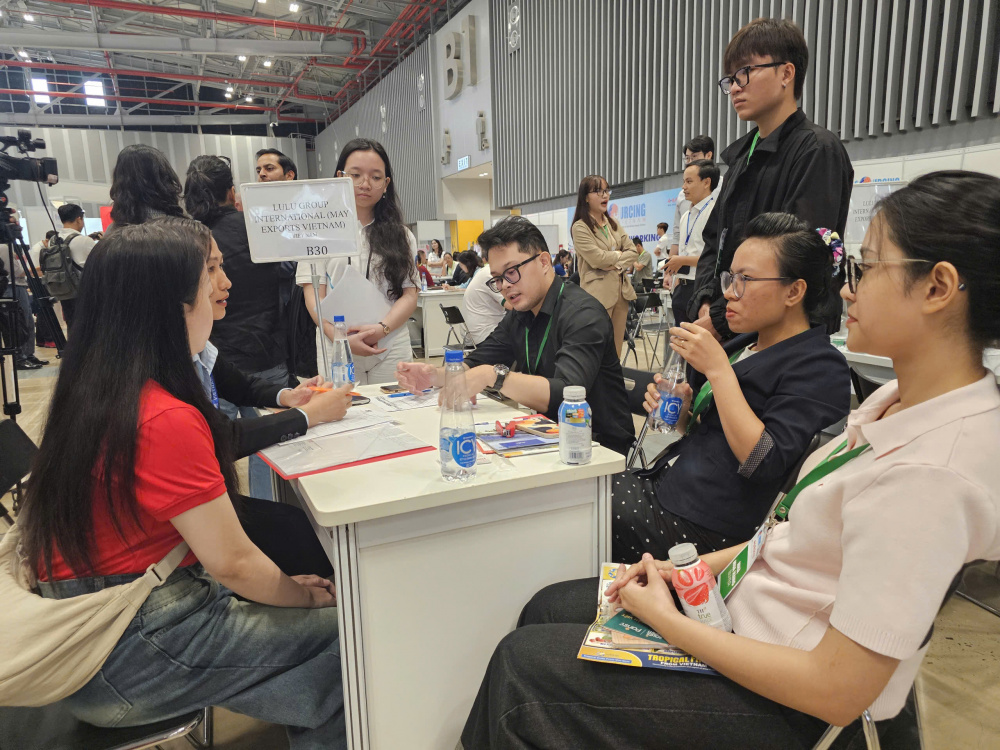
Executives Shaji Vasu and Fazal Veettil from Kami Foodstuff Trading L.L.C.—a leading Japanese food distributor in the UAE—said that their company currently imports dry, frozen and processed seafood from eight Asian markets including Japan, Thailand, India and Vietnam. Kami is expanding into other Middle Eastern countries while strengthening its market presence in the UAE.
In Vietnam, Kami is currently working through a single intermediary supplier that aggregates seafood sources from various factories. This arrangement ensures quality control and smooth export procedures to the UAE, allowing for fast customs clearance and efficient logistics. However, the company faces challenges such as higher pricing and limited product diversity. Through VIS 2025, Kami aims to build direct, stable partnerships with Vietnamese suppliers at more competitive prices, particularly for marine fish, soft-shell crab and other high-demand items.
Brazilian enterprises are also showing interest in sourcing Vietnamese seafood products—especially pangasius, tilapia, tuna and processed seafood—alongside rice, frozen fruits, coffee and spices. This rising demand reflects a broader trend: Latin American importers are diversifying supply chains and increasingly viewing Vietnam as a reliable alternative to traditional suppliers.
On the domestic side, Mr. Nguyen Thanh Ngoc, Deputy General Director of ASPIRA Group and representative of Cadovimex II (Seafood Processing and Import-Export Joint Stock Company), said the company’s booth drew crowds interested in tasting products such as whole-cut fish fillet sausages, Sichuan-style fish, Hong Kong chili-garlic fish, breaded fillets, smoked fillets, potato-wrapped shrimp, dim sum, premium hotpot seafood balls and many others.
Cadovimex II operates a fully integrated 3F ecosystem—Feed, Farm, Food—together with partners LC Group, KMS Vina and Hoang Long. Mekong Aqua Feed ensures a stable supply of aquafeed; farms meet ASC and GlobalG.A.P. standards with full traceability; and modern processing facilities comply with global certifications such as BRC, FSSC, HALAL and BAP. Thanks to this closed-loop value chain, Vietnamese pangasius and basa reach global consumers not only with strong flavor and convenience but also with guarantees of safety and sustainability.
Similarly, Ms. Sam Dieu Thanh, Director of AMIGO Seafood Processing Joint Stock Company in Hue, shared that her company specializes in fish cakes, seafood balls, noodle soup toppings and other seafood-based products. Their flagship surimi frozen products have been exported to Spain, China, South Korea, Japan, Thailand, Indonesia, Ukraine and more. Building on its established export portfolio of raw and semi-processed products, AMIGO is developing higher-value specialty items such as frozen traditional-style “cha ca quet” (pounded fish paste) to expand its global presence.
In its third year, Viet Nam International Sourcing 2025 has attracted 450 buying delegations from 60 countries and territories—ranging from traditional markets such as the United States, the European Union, Japan and South Korea to emerging regions including the Middle East, Latin America and Eastern Europe. The event opens new opportunities for Vietnamese enterprises to leverage the 17 Free Trade Agreements that Vietnam is currently implementing, explore new markets, reduce dependence on a limited number of regions and broaden their strategic export vision.
More than 3,000 scheduled B2B meetings and an additional 5,000 spontaneous B2B interactions at booths demonstrate the event’s strong appeal and reaffirm the confidence of both domestic and international enterprises in Vietnam’s supply capabilities.
The event not only helps Vietnamese businesses stay informed about market trends, consumer preferences and updated foreign regulations, but also enables international buyers, distributors and foreign enterprises to assess Vietnam’s production capacity and long-term supply potential. At the same time, VIS 2025 offers visitors an opportunity to discover the richness and cultural identity of Vietnam’s people and products.
Việt Thành