Events
Expanding the Domestic Market for the Food Industry
Through trade promotion activities and business matching, the Ministry of Industry and Trade is striving to expand the market for the food industry, which holds substantial potential.
Enterprises strive to affirm their position in the domestic market
Vietnam’s food industry is entering a phase of strong growth, thanks to a clear improvement in income levels, rising consumer demand and the growing number of enterprises. At present, the country has more than 5,000 enterprises operating in this sector.
Mr. Vu Ba Phu, Director General of the Vietnam Trade Promotion Agency (Ministry of Industry and Trade), has noted that Vietnam’s food industry is recording impressive revenue growth, in which processed vegetables and fruits have risen to account for nearly one quarter of the entire sector. This is an opportunity for enterprises to affirm their brands right in the domestic market.
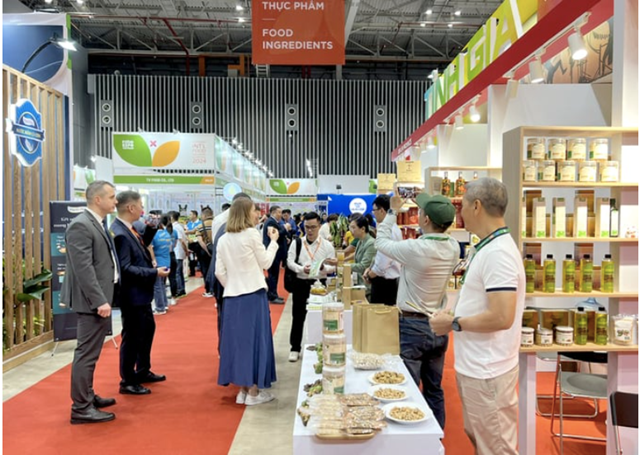
In reality, consumption of food and beverages in Vietnam has increased significantly in recent years. Notably, the processed vegetables and fruits segment accounts for as much as 24.7% of total revenue growth of the sector, while profits have even risen by 205%. Key products such as mango, banana, dragon fruit, orange, pineapple, and others have become bright spots not only in domestic consumption but also in the drive towards export.
It can be seen that, together with groups of products such as alcohol–beer–soft drinks, dairy processing, vegetable oil, flour and starch, the food industry has made an important contribution to the structure and value of national industry. This is also a field that the Government has prioritized for development to 2025, with a vision to 2035, with clear orientations on raising the rate of processing, applying international standards, building brands and enhancing competitiveness.
Within this picture, enterprises have been making efforts to expand their market share at home. In many localities, especially key agricultural regions such as Hai Phong, a series of specialty products have established their brands: Thanh Ha lychee, Nep Cai Hoa Vang glutinous rice, Chi Linh hill chicken, mung bean cakes, Ninh Giang black glutinous rice cakes, and others. However, most processing facilities are still small household businesses (accounting for up to 98%), lacking close linkages between production and consumption.
Many localities also report that if agricultural and food products are to secure a lasting foothold, obstacles related to land accumulation and credit capital must be removed, so that small-scale producers can link up and participate in the value chain of processing and distribution.
The Ministry of Industry and Trade accompanies and creates a “playing field” for connection
Alongside the efforts of enterprises themselves, the companionship of regulatory bodies, especially the Ministry of Industry and Trade, plays an important role in expanding the market for the food industry. In recent years, a series of trade promotion events have been implemented, becoming “bridges” to help enterprises promote their brands, connect and increase cooperation opportunities.
First and foremost is the Vietnam International Food Industry Exhibition (Vietnam Foodexpo) – the major annual event of the sector. At the 2024 edition alone, more than 500 booths of nearly 400 domestic and foreign enterprises gathered in Ho Chi Minh City. The event not only honored Vietnamese food brands but also served as a “grand showcase”, offering visitors a rich experience ranging from agricultural products and seafood to processed foods, beverages, processing technologies and packaging.
Moving into 2025, Vietnam Foodexpo, expected to be held in November 2025, will expand its scale to 600 booths from more than 23 countries and territories. With business-matching programs, specialized seminars and special display zones, the exhibition is expected to become a launchpad helping Vietnamese food enterprises accelerate access to both domestic and international markets, while keeping pace with green and sustainable consumption trends.
In parallel, Vietnam International Sourcing (VIS 2025) – a series of events connecting international supply chains – is taking place alongside the Export Forum and the Ho Chi Minh City International Travel Expo. VIS 2025 has attracted 450 buying delegations from 60 countries, together with more than 400 Vietnamese enterprises showcasing 12,000 products over an area of 10,000 m².
Speaking at the opening ceremony, Deputy Minister of Industry and Trade Phan Thi Thang emphasized that Vietnam International Sourcing not only promotes products but also creates investment flows, helping Vietnamese enterprises connect directly with global supply chains.
The proactive participation of localities at VIS 2025 is also a notable highlight. Rather than stopping at product displays, many provinces and cities have worked to bring foreign business delegations to their localities to survey the investment environment and learn about key products. Thus, opportunities to expand markets are not confined within the fair itself, but are spread directly into the value chain of production–processing–consumption.
It can be seen that large-scale trade promotion activities such as Vietnam Foodexpo and Vietnam International Sourcing are not only “playing fields” for trade but also concrete evidence of the State’s practical companionship with enterprises. Thanks to this, Vietnamese food products are increasingly affirmed in the domestic market, while at the same time creating a solid foundation for deeper penetration into global supply chains.
The food industry, with its vast development potential, is becoming one of the important driving forces of Vietnam’s economy. The domestic market, with rising consumer demand, is identified as “fertile ground” for enterprises to build their brands, improve quality and create sustainable value.
The companionship of the Ministry of Industry and Trade through trade promotion activities, fairs and international exhibitions has been and is opening up new opportunities, connecting enterprises with markets, thereby creating solid progress for Vietnam’s food industry in an era of deep international integration.
Việt Thành