Export performance in the first half of 2025
According to statistics from the Ministry of Agriculture and Environment, export turnover of forestry products in the first six months of 2025 is estimated at over USD 8.2 billion, an increase of 8.9% compared with the same period in 2024. Within this structure, wood and wood products remain the “locomotive”, accounting for around 67.3% of total forestry export value and ranking among the seven largest export groups of Viet Nam.
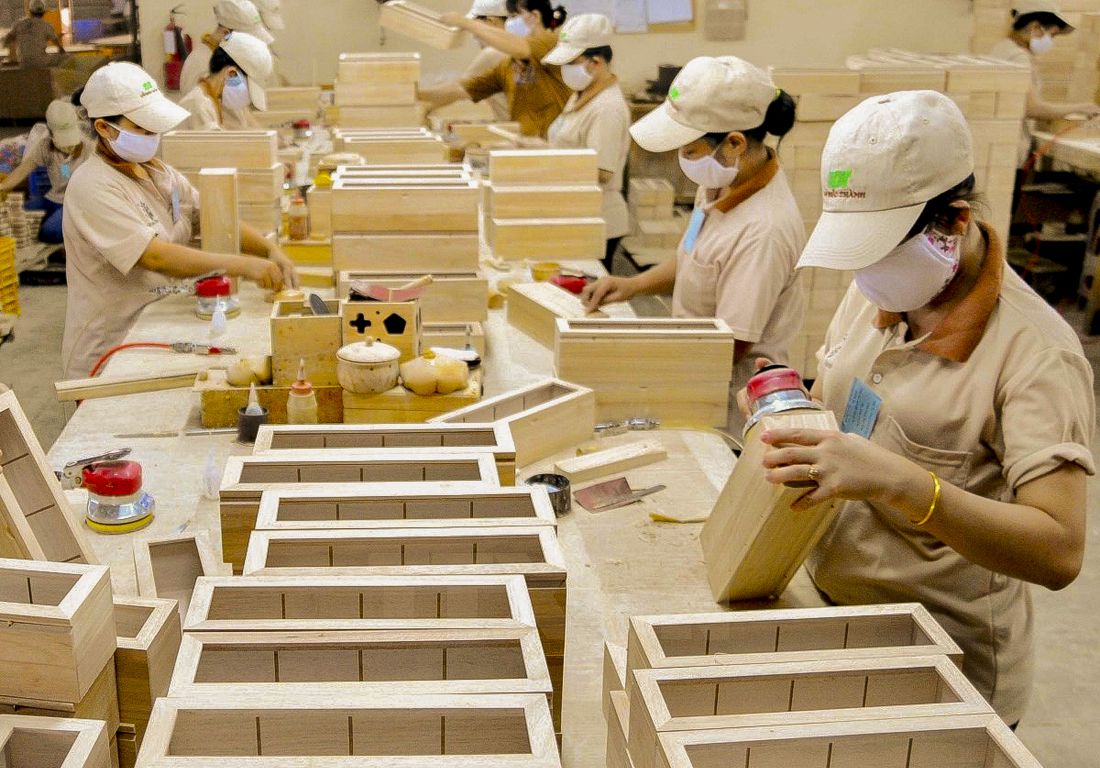
Behind these impressive figures, however, lies a noteworthy trend: the growth rate of wood and wood product exports has slowed compared with the 23.5% recorded in the first half of 2024. The industry is still growing, but no longer experiencing the “hot growth” seen in the strong post-pandemic recovery phase; instead, it is moving into a trajectory of more stable growth, more tightly bound to new conditions and constraints in international markets.
In terms of market structure, the United States continues to affirm its role as the key market. Export turnover of wood and wood products to the US in the first half of 2025 is estimated at about USD 4.6 billion, up 11.6% year-on-year and accounting for as much as 55.6% of the sector’s total export value. Japan and China are the next two major markets, with shares of 12.6% and 10.4% respectively. In addition, the EU, South Korea, the Middle East and several Oceanian countries are gradually becoming important “satellite” markets, adding new room for growth.
It can be seen that Viet Nam’s wood industry has built a fairly broad market foundation, with wood products present in more than 160 countries and territories. However, the very high level of dependence on a few large markets – especially the US – makes the sector more vulnerable to policy shifts and rising protectionist tendencies.
Trade barriers and geopolitical pressure
In the 2024–2025 period, Viet Nam’s wood industry faces a series of external challenges arising from three overlapping layers of risk: tariff and trade-remedy policies; new regulations on environment and sustainability; and intensifying competition in raw materials, labour and technology.
The first layer of risk stems from tariff measures and trade-remedy actions taken by major markets. The US plan to impose retaliatory tariffs on certain Vietnamese products, together with anti-dumping and countervailing duty investigations, have created significant “noise” around export operations. For plywood in particular, the US Department of Commerce has initiated investigations against more than 130 Vietnamese processing and exporting enterprises. The risk of additional duties has led many US buyers to scale back long-term contracts, switch to shorter-term deals and repeatedly renegotiate prices and delivery conditions.
The second layer of risk relates to green policies and sustainability requirements. In Europe, the EU Deforestation-free Products Regulation (EUDR) requires imported wood products to prove they are not associated with deforestation or forest degradation, through detailed data on planting areas, geographic coordinates and supply chains. At the same time, the Carbon Border Adjustment Mechanism (CBAM) and the Corporate Sustainability Reporting Directive (CSRD) oblige importing groups to raise their environmental, social and governance (ESG) reporting standards, which in turn tightens requirements on suppliers. Japan has also strengthened requirements for legal timber origin, prioritising wood from certified sustainable forests, and has adjusted energy prices, directly affecting electricity-intensive segments such as wood pellet production, drying, pressing and surface treatment.
The third layer of risk concerns raw materials and competition. Prices of imported timber are rising as many countries restrict exports and prioritise deeper domestic processing. Some traditional supply sources have been disrupted by conflict and sanctions, pushing up costs for shipping, insurance and delivery times. At the same time, Viet Nam is competing head-on with “wood powers” such as China, Malaysia and Indonesia – countries that possess advantages in production scale, raw-material self-sufficiency and technological level.
In this context, as many enterprises have shared, Viet Nam’s wood industry is not only “straining to maintain growth” but also gradually repositioning itself to adapt to a “new trade order”, where low price is no longer the only advantage.
Responding through supply-chain transparency and legal strength
Faced with trade-remedy investigations and the risk of new tariffs in key markets, Viet Nam’s wood industry has shifted from a passive stance to a more proactive approach in legal preparedness.
The Viet Nam Timber and Forest Products Association, in coordination with businesses, has been preparing documentation and data to be ready for hearings requested by the US side, stressing the complementary role of Viet Nam’s wood sector in global supply chains rather than any injury to US domestic production. Relevant ministries and agencies – especially the Ministry of Agriculture and Environment, the Ministry of Industry and Trade and the Ministry of Foreign Affairs – have also stepped up engagement with US counterparts to clarify the specific characteristics of plantation forestry and wood processing industries in Viet Nam.
At the enterprise level, many firms have begun building internal systems to manage trade-remedy risks, collecting and storing comprehensive documentation on costs, raw-material sources, labour and origin. Experience shows that companies with transparent supply chains, sound management systems and proactive cooperation with investigating authorities tend to weather trade-remedy actions with less damage.
At the same time, strengthening supply-chain transparency is not only about “coping with investigations” but is also a prerequisite for meeting new standards in the EU, US and Japan regarding legal timber, anti-deforestation and social responsibility. From a long-term perspective, this is an investment in competitiveness, not just a compliance cost.
Shifting toward green growth and higher value added
Legal “defence” alone, however, is not enough. Pressure from tariffs, investigations and green standards is forcing the wood industry to move from a growth model heavily based on volume and processing towards one based on value added, design and sustainability.
Commenting on this trend, Mr. Ngo Sy Hoai, Secretary General of the Viet Nam Timber and Forest Products Association, emphasised that the prospect of higher US tariffs is a reminder for the industry to “reorganise its ranks and reset its mindset”. Achieving the goal of remaining the largest wood supplier to the US does not rest solely on price and production capacity; it must be built on green processing, green trade and green growth. Wood processing is particularly sensitive to environmental protection, forest conservation and climate change; if the industry does not lead on sustainability, it will be difficult to maintain its position in the long run.
At the enterprise level, this requires stronger investment in clean production technologies, waste-treatment systems, energy management and process optimisation. It also calls for a shift in focus from contract manufacturing based on buyers’ designs to proactive product development, brand building, provision of complete interior solutions, smart furniture and product lines that tell stories about green lifestyles and resource efficiency.
Many Vietnamese companies have started mastering supporting stages such as producing fittings, metal components, and environmentally compliant paints and adhesives, thereby raising the localisation rate of the value chain. Domestically controlled timber now accounts for around 60–65% of total raw-material needs – an important foundation for gradually meeting future requirements on legal origin and sustainable forest management.
Market diversification and geographic rebalancing
A key lesson emerging in recent years is that excessive reliance on a few markets makes the sector highly vulnerable to policy shocks. Market diversification is therefore not just a recommendation but a matter of survival.
In addition to consolidating traditional markets such as the US, EU, Japan and South Korea, Viet Nam’s wood industry is paying closer attention to emerging regions. The Middle East is regarded as a promising market with rapidly growing demand for home furniture, hotel interiors and commercial-centre fit-outs. India – with its expanding middle class – is also emerging as an attractive furniture market; negotiations on a Viet Nam–India FTA, if successful, could substantially lower import tariffs on wood products and open significant opportunities for Vietnamese exporters. In regions such as Africa, South America, Eastern Europe and Northern Europe, demand for construction timber, flooring, engineered boards, interior furniture and deep-processed products is also rising, creating multiple “niches” well-suited to the flexibility of small and medium-sized Vietnamese firms.
To ensure diversification is more than just rhetoric, the sector needs to combine this with careful research into legal frameworks, technical standards, consumer preferences and local distribution networks, rather than limiting efforts to occasional trade fairs and promotion missions.
Policy orientation and the need to upgrade internal capacity
At the macro level, enabling the wood industry not only to withstand shocks but also to break through in the 2025–2030 period will require a comprehensive package of solutions on institutions, infrastructure and business support.
First, the legal framework for legal timber and sustainable forests must be further refined, ensuring all products consumed domestically and exported have clear and transparent origin. Policies on large-diameter plantation forests and certified sustainable forests must be implemented in a substantive way, linked with preferential schemes on credit, land and science-and-technology to encourage long-term investment by forest growers and enterprises.
Second, the development of concentrated wood-processing industrial zones and clusters with modern environmental-treatment infrastructure and advanced technology is a necessary condition for raising the share of processing and preservation facilities that meet modern standards. Once, by a given milestone, the majority of facilities reach advanced technological levels, the industry will be better positioned to close the gap with regional competitors.
In parallel, support programmes for green transition and digital transformation in enterprises need to be designed in a more systematic manner, focusing on core issues such as energy optimisation, automation, implementation of ERP systems and platforms for traceability and customer-data management. Economic diplomacy in forestry and wood products should also be strengthened, so that the sector’s interests become an integral part of bilateral and multilateral cooperation agendas.
For businesses, the 2025–2030 period is a true “watershed moment” to upgrade management to international standards, become more proactive in design and product development, build brands and participate more deeply in chain linkages with forest owners, component suppliers and logistics providers.
Conclusion: Weathering the “storm” to enter a new growth cycle
Viet Nam’s wood industry is undergoing a major test. Tariffs, trade-remedy investigations, green standards and regional competition are all strong headwinds. Yet they also create an opportunity for the sector to screen itself, consolidate its internal strength and reposition at a higher tier in global value chains.
If supply-chain transparency is seen as the foundation, green development as the strategic axis and market diversification as the risk buffer, Viet Nam’s wood industry can indeed turn today’s challenges into momentum for a new growth cycle. Close coordination between the State, industry associations and enterprises will be the key to ensuring the sector not only maintains its status as one of the world’s leading wood exporters, but also builds the image of a responsible, modern and sustainable wood industry in the eyes of international partners.
Việt Thành