Events
Keys to Helping Vietnamese Goods Reach Further in the New Context
In the long term, diversification not only helps reduce risks but also lays the foundation for Vietnam to build a national brand as a reliable, sustainable and responsible partner in global trade.
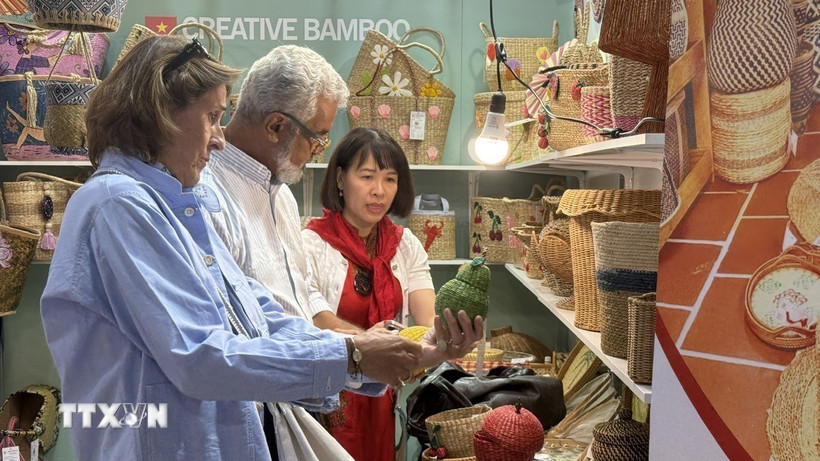
Customers explore products at the booth of a Vietnamese enterprise. (Photo: Hữu Chiến/TTXVN)
In a rapidly changing global economy, the challenge of expanding Vietnam’s export markets has become more urgent than ever. However, alongside the challenges, opportunities grow even larger if businesses proactively develop the right strategies.
This was the focus of discussions at the seminar “Market Diversification Strategy: From Risks to Opportunities,” organized by the Ministry of Industry and Trade and the Ho Chi Minh City Investment and Trade Promotion Center on September 5.
Tạ Hoàng Linh, Director General of the Department of International Market Development (Ministry of Industry and Trade), noted that relying solely on a few traditional markets exposes businesses to major risks.
Meanwhile, the long-standing strategy of diversifying markets, products and supply chains that Vietnam has consistently pursued has proven its effectiveness.
Experiences from the pandemic, geopolitical fluctuations and trade wars have shown that in any crisis, flexibility and long-term vision help Vietnamese businesses strengthen their position.
“Vietnam’s major advantage is its highly open economy, with 17 free trade agreements that not only provide tariff incentives but also open doors to potential regions such as Latin America, the Middle East and the Eurasian Economic Union. The key question is not whether markets exist, but how ready businesses are to access and adapt to them,” Tạ Hoàng Linh emphasized.
Offering an overview of the Latin American market, Veronica Alcaraz Silva, Country Director of Coppel Vietnam, said Latin America is a vast region with more than 600 million people, a fast-growing middle class and diverse consumer demand.
In this region, the Comprehensive and Progressive Agreement for Trans-Pacific Partnership (CPTPP) has helped Vietnamese goods gain more presence in Mexico and Chile. Brazil is also considered a highly promising market.
In reality, Latin American consumers have uneven incomes, with most needing affordable products that still meet safety standards. With advantages in cost efficiency, Vietnam’s textiles, footwear and electronics can compete strongly.
From a positive perspective, Coppel—with more than 1,800 stores in Mexico—highly values Vietnam’s manufacturing capabilities. This indicates that if Vietnamese enterprises increase their self-sufficiency in raw materials, they can fully break through in this vast yet often overlooked market.
Mirash Basheer, Director of May Exports Vietnam under Lulu Group, affirmed that the Middle East is a “golden gateway” for connecting trade flows from Asia to Europe and Africa.
With more than 400 million people and high incomes, the region has strong consumption demand, particularly for Halal products, making it an attractive destination for exporters.
Lulu Group has been importing goods from Vietnam for more than 10 years and considers Vietnam one of its key supply sources in Asia. The main challenges now stem from increasing geopolitical tensions affecting logistics and strict Halal certification requirements.
However, the signing of the Vietnam–UAE Comprehensive Economic Partnership Agreement (CEPA) has opened a more favorable trade corridor, reducing tariff burdens. Vietnamese enterprises need to prioritize developing products and services that obtain Halal certification.
This not only enables more exports but also enhances product quality to meet stringent standards, thereby elevating Vietnam’s national brand in international markets.
Per Ljungblad, a representative of IKEA, observed that Northern Europe is an ideal market for Vietnamese wood and furniture, but it has extremely high sustainability requirements.
Sustainability is assessed not only on the final product but across the entire value chain—from raw materials and production methods to CO₂-emission reduction roadmaps. Notably, Vietnam has abundant sources of bamboo and rattan, materials increasingly favored in Europe but still underutilized. This is a unique “green” advantage that few regional countries possess.
Beyond mass-market items, Vietnam’s interior, exterior and handicraft industries need to leverage local natural materials to create distinctive products.
However, Ljungblad also emphasized that small enterprises participating in global supply chains must ensure stable volumes and consistent quality. This means businesses must go beyond merely fulfilling orders—they must maintain long-term credibility and environmental responsibility.
Drawing from real-world experience working with global supply chains, Huỳnh Lê Đại Thắng, Director of Nghĩa Sơn Furniture Co., Ltd., identified the European Union’s EUDR regulation—which fully takes effect at the end of 2025—as the biggest challenge. The regulation requires strict traceability to ensure no deforestation.
Many Vietnamese enterprises have not invested adequately to meet this requirement, while European buyers evaluate extremely rigorously.
Huỳnh Lê Đại Thắng emphasized that to penetrate deeply into the EU or the U.S. markets, businesses must seriously invest in technology, market research and continuous product improvement.
In practice, each market has its own standards; one product cannot fit all. This serves as a “test” of the adaptability and open-mindedness of Vietnamese enterprises.
Michel Verdy, Chairman of the Quebec–Vietnam Association, highlighted that bilateral trade between Vietnam and Canada stands at only 5 billion USD—modest compared to its potential. In addition to familiar products such as agricultural goods, textiles and coffee, Canada sees opportunities to cooperate with Vietnam in high technology, artificial intelligence and e-commerce.
With a young and skilled workforce, Vietnam can become Canada’s strategic partner in the digital era. Importantly, market diversification is not only about geography but also the fields of cooperation.
Alongside new markets, Nguyễn Thảo Hiền, Deputy Director General of the Department of International Market Development, stated that exporters should also “revitalize” traditional markets.
Specifically, for the Eurasian Economic Union (EAEU), although not a new market, it remains under-exploited. The Vietnam–EAEU Free Trade Agreement, effective since 2016, brought over 80% of tariff lines to zero, and exports once grew 20–30% annually but have recently slowed due to geopolitical instability.
Notably, Vietnamese enterprises are making good use of tariff preferences, with more than 70% of export turnover benefiting from the FTA. Vietnamese textiles, agricultural products and seafood continue to be well received in the EAEU market.
Opportunities become even clearer as many other suppliers to Russia face legal obstacles, while Vietnam faces no trade restrictions. If Vietnamese enterprises take advantage and capture market share now, they will enjoy a superior competitive edge once the situation stabilizes.
“The current difficulty lies mainly in restrictions on USD payments, but local-currency payments are feasible. With export turnover in 2024 exceeding 3 billion USD, the EAEU is clearly a ‘treasure trove’ with vast potential for many Vietnamese export sectors. Sometimes the opportunity is not far away—it lies in the markets we already know well,” Nguyễn Thảo Hiền added.
Experts emphasize that Vietnam’s market diversification strategy is an inevitable choice. Each region poses its own challenges—from geographic distance to sustainability requirements—yet also offers opportunities that, if seized well, can help Vietnamese enterprises advance further along global value chains.
Importantly, businesses cannot move forward alone. Alongside internal upgrades, they require continued support from regulatory agencies in market intelligence, partner connections and maximizing the benefits of FTAs.
In the long term, diversification not only reduces risk but also forms the basis for Vietnam to build a national brand as a trusted, sustainable and responsible partner in global trade.
Hữu Hưng