Events
Foreign Enterprises Sourcing Goods in Tay Ninh: From 8 MOUs to a Strategy of “Embedding the Province into Global Supply Chains”
The 2025 Conference on “Connecting Import–Export Goods Supply Chains and E-commerce” in Tay Ninh was not only about impressive figures – more than 600 delegates, 142 international enterprises, 25 countries and territories, and 8 memoranda of understanding signed – but also marked a qualitative shift in how the Ministry of Industry and Trade and local authorities conduct promotion. The goal is to turn Tay Ninh into a new “node” on the supply chain and logistics map of the southern region.
Tay Ninh in the Ministry of Industry and Trade’s “New Supply Chain Vision”
Speaking at the conference, Deputy Minister of Industry and Trade Phan Thi Thang emphasized that the scale of the event and the number of participants far exceeding expectations are clear signals of Tay Ninh’s new economic attractiveness to both domestic and foreign businesses. From a policy perspective, this is not just a provincial-level conference, but a link in the chain of activities implementing the nationwide orientation of “connecting import–export goods supply chains and e-commerce” that the Ministry of Industry and Trade is pursuing.
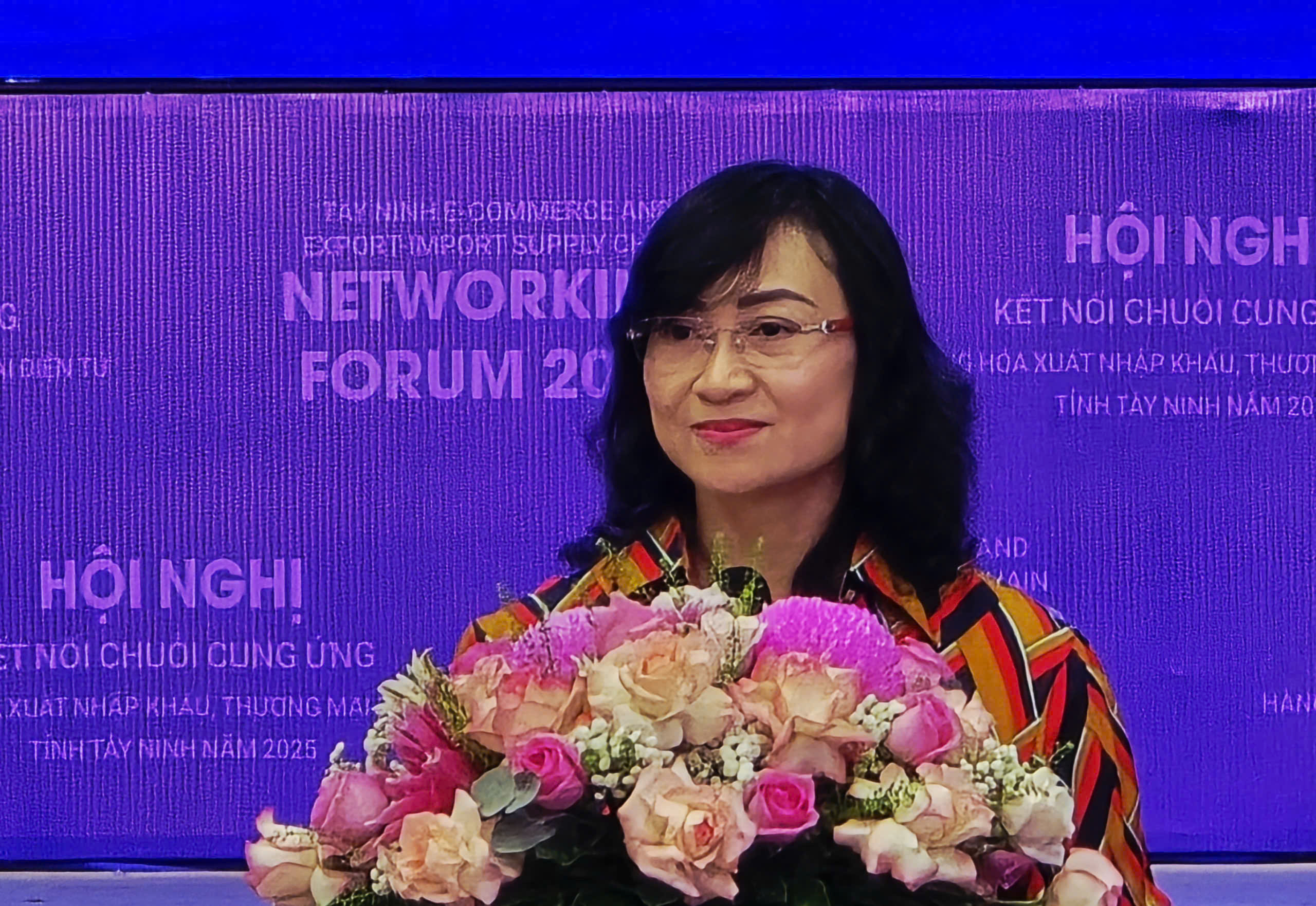
According to the Ministry’s assessment, Tay Ninh enjoys a strategic advantage by sitting on the economic corridor connecting Ho Chi Minh City – Long An – Tay Ninh – Moc Bai International Border Gate. It is a point of intersection between the Southern Key Economic Region and the Cambodian market and the wider Mekong sub-region. In the new development planning, the “integration” of Tay Ninh with Long An creates a broader economic space, with more synchronized infrastructure and greater room to extend supply chains deeper into the domestic market.
In the context of global supply chains being restructured, many distribution and e-commerce groups such as Central Retail, Aeon, Walmart, Amazon and Alibaba are looking for new sourcing hubs beyond the traditional centers. Localities like Tay Ninh – with substantial potential for industrial development, agricultural processing and logistics – are increasingly coming onto the radar of international investors.
Conference Scale and the “Upgraded Nature” of Promotion Activities
The 2025 conference, held at Thong Nhat Hall of the Tay Ninh Provincial People’s Committee, brought together more than 600 delegates, including 142 international enterprises from 25 countries and territories, and the participation of many leading distribution and e-commerce groups such as Central Retail, Aeon, Walmart, Amazon and Alibaba. In essence, this was not merely a conference to introduce local products, but a multi-layered “connection platform” between:
– Manufacturing and exporting enterprises from Tay Ninh and the southern region and global purchasing systems;
– Logistics actors – seaports, warehouses, transport services – and intercontinental transport routes;
– Traditional distribution channels and cross-border e-commerce platforms.
The conference sessions focused on two main themes: import–export goods supply chains and e-commerce. This choice directly reflects the bottlenecks and needs of local businesses: they do not only need outlets for their products, but also need to be “connected in the right way” into logistics, finance and digital trade systems to shorten the distance between producers and end-consumers in international markets.
Eight MOUs: A “New Relationship Map” Between Tay Ninh and the World
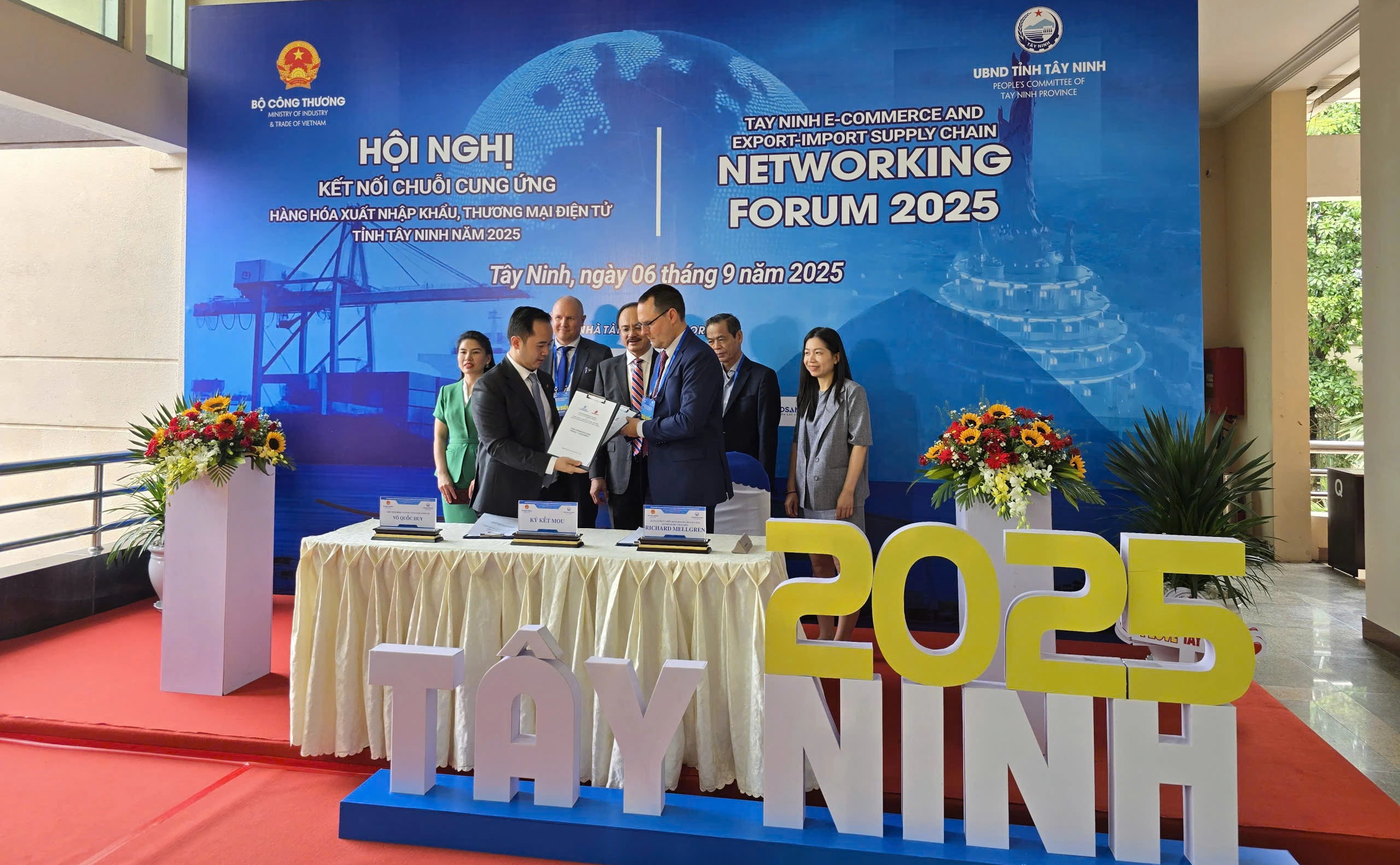
The most notable highlight of the conference was the signing of 8 memoranda of understanding on cooperation between Tay Ninh and international partners. From a value-chain perspective, these are not just symbolic documents, but a “new relationship map” that helps shape the structure of connections between Tay Ninh and global distribution, logistics and investment networks.
First, the group of agreements between the Tay Ninh Department of Industry and Trade and the Chamber of Commerce and Industry of Latvia, Central Retail Group and Alibaba shows an approach that simultaneously touches all three “pillars”: connecting with a European Chamber of Commerce to expand B2B contact channels; linking with a major regional retailer (Central Retail) to strongly tap the ASEAN market; and cooperating with a cross-border e-commerce platform (Alibaba) to bring Tay Ninh’s products onto global “marketplaces”.
– Cooperation with the Chamber of Commerce and Industry of Latvia opens up opportunities to access the North–Eastern European corridor, where demand for agricultural products, processed foods, wood products and consumer goods is growing, while Vietnamese enterprises still have limited presence. Latvia is not only a standalone market, but also an important transit point on European logistics routes.
– The agreement with Central Retail allows Tay Ninh to “shortcut” into supermarket systems, shopping centers and modern retail chains in Viet Nam and the region, creating a solid foundation for standardizing quality, building traceability and improving packaging – from there raising standards to move onto international markets.
– Cooperation with Alibaba directly addresses the challenge of cross-border e-commerce. This channel can scale up quickly, but requires local enterprises to invest in digital capabilities, handling of small-lot orders, inventory management and last-mile logistics tailored to each market.
Second, the group of agreements between the Tay Ninh Business Association and May Viet Nam Export Company – Lulu Group, the Vietnamese Business Association in Japan and the Indian Business Chamber in Viet Nam (INCHAM) reflects another direction of travel: leveraging “bridge-builder business communities” to open pathways for Tay Ninh products into Middle Eastern, South Asian and Japanese markets.
– Lulu Group is one of the largest retail systems in the Middle East, with stable demand for agricultural products, processed foods and fast-moving consumer goods. The agreement with this group gives Tay Ninh’s products the opportunity to access a large-scale distribution channel with very specific requirements on certification, packaging and traceability.
– The Vietnamese Business Association in Japan and INCHAM are two effective “bridges” to bring local products into existing supply chains in Japan and India – markets that are both promising and highly demanding in terms of quality, technical standards and social responsibility.
Third, the cooperation agreement between Long An International Port and the Port of Portland (USA) and the Port of Gothenburg (Sweden) has profound implications for logistics structure. Long An is the gateway seaport for the Mekong Delta and the area adjoining Tay Ninh – Long An – Ho Chi Minh City; Portland and Gothenburg are important ports on the trans-Pacific and Northern European shipping routes. Establishing this trilateral cooperation opens up the possibility to:
– Design more optimal transport routes for agricultural, aquatic and processed goods from Tay Ninh and neighboring areas to the US and European markets;
– Promote standardization of cold chains and containers and the adoption of emission-reduction solutions in logistics, in line with the trend of “greening” supply chains.
In addition, the interest of a Singaporean enterprise in investing in a food processing plant in Tay Ninh shows that the effect of “attracting FDI into deep processing” is gradually emerging. If implemented, such a project will not only increase processing capacity, but also drive the formation of linked raw material regions, raise agricultural production standards and create more jobs for the locality.
Two-Way Benefits: the Province Gains “Future Orders”, Partners Gain “Reliable Supply”
With the agreements signed, Tay Ninh has a clearer view of the “future orders” for its key sectors: agricultural products, processed foods, consumer goods, supporting industries and logistics services. If the province and its enterprises make good use of this, the memoranda can be translated into contracts, orders and investment projects in the coming years.
Conversely, international partners see Tay Ninh as a destination that brings together three key factors:
– A strategic location that can act as a transit point for goods between the Southeast region, Cambodia and the southern seaport system;
– Significant room to develop processing industries, warehousing and logistics as transport infrastructure (roads, expressways, border gates) is being expanded;
– A diverse supply of goods from agricultural products and foods to consumer items, with the capacity to configure products to suit each market if properly supported on standards, design and packaging.
As Deputy Minister Phan Thi Thang noted, this conference is not only about exchanging views on market trends and cooperation opportunities, but also about opening up prospects for building sustainable supply chains and enabling Tay Ninh’s products to “go further and stay longer” in international markets.
E-commerce and the Digital Capacity Challenge for Local Enterprises
The presence of major e-commerce platforms such as Amazon and Alibaba at the conference shows that cross-border e-commerce is no longer a “secondary channel”, but is being designed as one of the pillars of the locality’s new export strategy.
For Tay Ninh’s enterprises – especially small and medium-sized ones – e-commerce offers opportunities to directly reach consumers in markets where they were previously almost “invisible”. However, this opportunity comes with requirements on digital capacity: managing product information, images and descriptions; handling small-lot orders; building customer service systems; and ensuring the ability to meet delivery times, quality requirements and response expectations.
In this context, training and advisory programmes on e-commerce, digital transformation and customer data management need to be stepped up in parallel with connection activities under the principle of “once we shake hands, we must be able to deliver”. If enterprises only stop at opening an online storefront without upgrading their internal capabilities, it will be difficult for them to maintain a long-term presence on international e-commerce platforms.
From “A Successful Conference” to “A Strategy for Upgrading Local Value Chains”
In the short term, the 2025 Conference on “Connecting Import–Export Goods Supply Chains and E-commerce” in Tay Ninh can be considered a successful promotion event, with impressive numbers and 8 memoranda of understanding signed. However, the long-term significance of the conference will only truly be confirmed if Tay Ninh and its business community can leverage it as a starting point to:
– Proactively review their product structure, select sectors capable of quickly meeting partners’ requirements and prioritize investment in upgrading them;
– Strengthen linkages between processing enterprises and raw material regions to ensure stability and traceability of supply chains;
– Invest heavily in local logistics systems to connect more effectively with Long An International Port and main transport corridors;
– Upgrade digital capabilities, product design, quality management and compliance with international standards in order to fully exploit modern distribution channels and e-commerce.
When the signed cooperations are materialized by the first shipments, the first deep-processing investment projects, and the first online storefronts of Tay Ninh enterprises on global platforms, the spillover effects of the conference will become truly visible.
From a broader perspective, the Tay Ninh 2025 event reflects a new approach by the Ministry of Industry and Trade to promotion: instead of focusing only on fairs in major hubs like Ha Noi and Ho Chi Minh City, the Ministry is gradually “bringing the world to the localities”, placing provinces with strong potential like Tay Ninh in a proactive position on the national supply chain map. If consistently implemented, this approach will help shorten the distance between the central and local levels and turn new growth poles such as Tay Ninh into important drivers in Viet Nam’s international economic integration strategy in the coming period.
Việt Thành