The News
Adapting to a New Context, Export Strategies Must Become More Flexible
Amid global pressures, Vietnam’s exports require new strategies to maintain stable growth, ensure sustainable development, and reduce dependence on traditional markets.
Market diversification – an essential direction for Vietnam’s exports
Given global economic volatility, finding new pathways for Vietnam’s exports has become urgent. In 2024, export turnover exceeded USD 405.5 billion, affirming the country’s role in global supply chains. However, dependence on traditional markets has increased exposure to trade barriers, geopolitical risks, and rising protectionism.
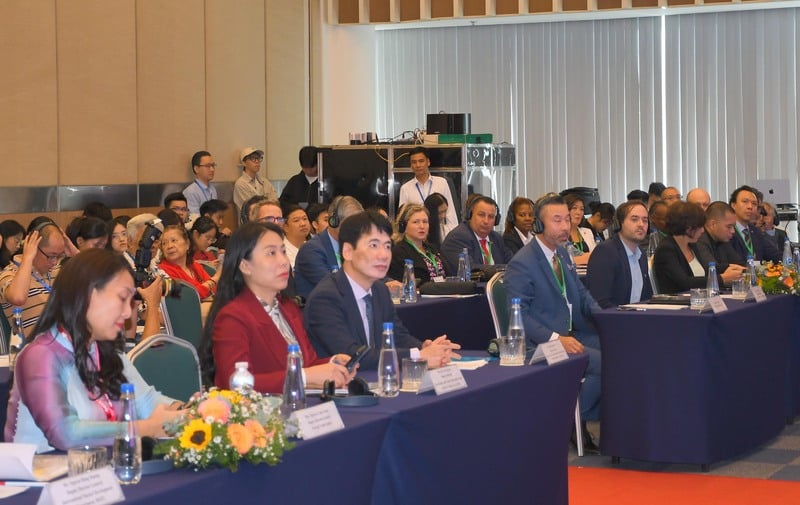
Delegates attending the event. Photo: Minh Khue.
To address these challenges, the Ministry of Industry and Trade, in coordination with the Ho Chi Minh City People’s Committee, organized the seminar “Market Diversification Strategy: From Risks to Opportunities” on the afternoon of 5 September 2025 at the Saigon Exhibition and Convention Center. The event, held within the framework of Vietnam International Sourcing 2025, gathered representatives from regulatory agencies, industry associations, exporting enterprises, and international partners.
Speaking at the seminar, Mr. Ta Hoang Linh, Director General of the Department of Foreign Market Development (Ministry of Industry and Trade), emphasized that the event took place amid unpredictable global economic developments, with numerous risks threatening global supply chains and international trade, such as geopolitical instability, rising protectionist measures, and escalating trade tensions following the United States’ announcement of new tariffs.
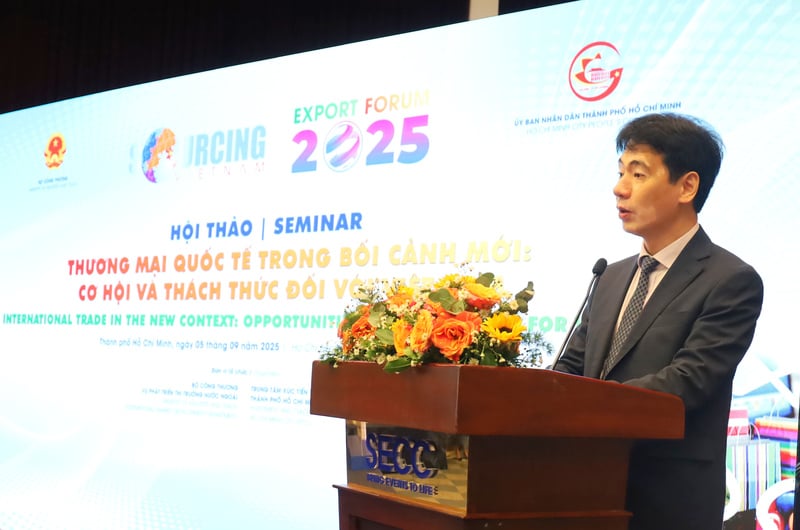
Mr. Ta Hoang Linh, Director General of the Department of Foreign Market Development. Photo: Minh Khue.
According to Mr. Linh, the landscape of international trade is presenting unprecedented challenges. Although new-generation FTAs such as CPTPP, EVFTA, and RCEP have opened vast market spaces, helping Vietnam expand exports and enhance competitiveness, global trade is showing signs of stagnation. The World Bank’s June 2025 report projects global GDP growth this year at only 2.3%, while the World Trade Organization (WTO) has downgraded global trade growth to 0.9%, a record low in recent years.
Alongside traditional barriers, Vietnamese exporters now face a wide range of system-level requirements: green transition, labor and environmental standards, supply chain transparency, and digital technology adoption.
These factors are progressively reshaping global supply chains. “Vietnam, as an open economy, must proactively adapt in a flexible manner while leveraging opportunities from investment shifts and supply chain restructuring,” Mr. Linh stressed.
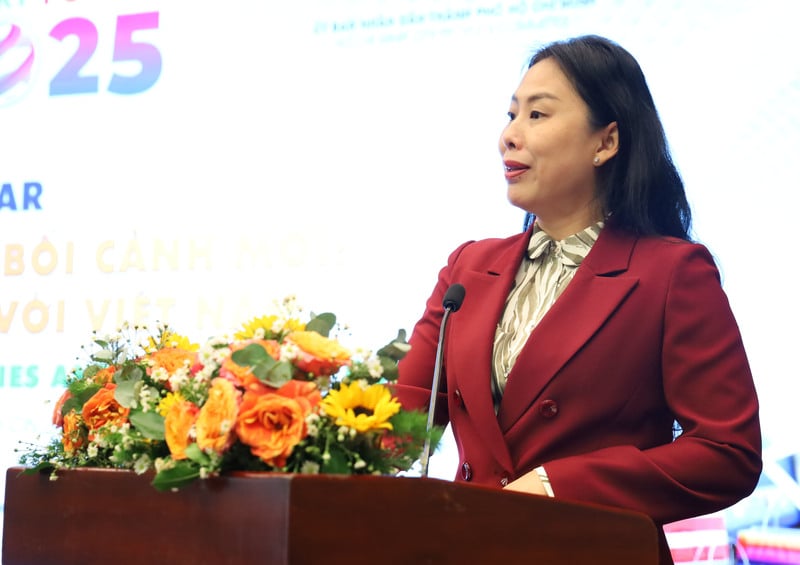
Ms. Ho Thi Quyen, Deputy Director of ITPC. Photo: Minh Khue.
From a local perspective, Ms. Ho Thi Quyen, Deputy Director of the Ho Chi Minh City Investment and Trade Promotion Center (ITPC), affirmed that the city will continue to accompany enterprises in their efforts to access international markets.
Ho Chi Minh City has implemented a wide range of support activities such as organizing fairs, trade connection events, thematic seminars, and export consulting services, helping enterprises expand partner networks, build strong brands, and adapt to market requirements.
However, Ms. Quyen also noted that Vietnamese enterprises continue to face major challenges such as technical barriers, complex tariffs, high logistics costs, and increasingly stringent sustainability requirements. In this context, Ho Chi Minh City is focusing on supporting enterprises in digital transformation, technological innovation, value-added enhancement, and promoting e-commerce as an effective channel for market expansion.
During the seminar, enterprises and experts analyzed emerging market trends, shared practical experience, and proposed pragmatic solutions aimed at strengthening resilience, improving competitiveness, and ensuring sustainable development for Vietnamese businesses.
All speakers agreed that market diversification is no longer a slogan but a matter of survival. Tapping into potential markets such as Latin America, the Middle East, Northern Europe, or Canada will help Vietnamese businesses reduce dependence, broaden growth opportunities, and elevate the global position of Vietnamese products.
Opportunities and challenges amid rising global trade protectionism
At the recent international trade seminar, the thematic panel discussion titled “Opportunities and Challenges for Vietnam in the Context of Rising Global Trade Protectionism” drew strong interest from leading experts and large enterprises. The session was moderated by Mr. Nguyen Hong Duong, Deputy Director General of the Department of Foreign Market Development (Ministry of Industry and Trade), with participation from a number of notable domestic and international speakers including: Ms. Nguyen Cam Trang, Deputy Director General of the Import-Export Department (Ministry of Industry and Trade); Mr. Do Ngoc Hung, Vietnam Trade Counselor in the United States; Mr. Victor Dulait, Managing Director of BeluxCham; Mr. Nguyen Xuan Linh, Chief Operating Officer of B’Lao – Scavi Group; Ms. Sarah Negro, Global Public Affairs Manager at H&M; and Mr. Nguyen Trung Dung, CEO of DH Foods.
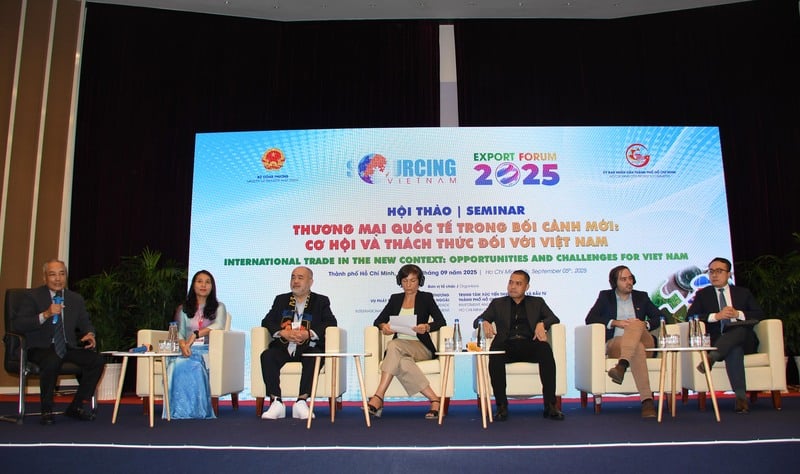
Speakers analyzing key issues during the panel discussion at the seminar. Photo: Minh Khue.
The panel focused on urgent topics such as rising protectionism, impacts of the United States’ new tax policies on Vietnamese enterprises, sustainable procurement strategies and supply chains, self-sufficiency in raw materials, and solutions to enhance competitiveness and expand market share for Vietnamese exports.
Opening the discussion, Mr. Nguyen Hong Duong emphasized major global trade trends such as green transition, supply chain restructuring, and protectionism, which are moving rapidly and can change “overnight.” Therefore, he noted that all forecasts are relative, and enterprises must adopt flexible, creative mindsets to adapt to actual developments.
He also highlighted that Vietnam is facing profound structural shifts, requiring not only policy adjustments but also fundamental changes in governance mindset and business strategies. Importantly, he underscored the role of multidimensional engagement and dialogue between policymakers and enterprises to identify optimal and sector-appropriate solutions.
Ms. Nguyen Cam Trang, Deputy Director General of the Import-Export Department, shared several significant insights. She affirmed that although Vietnam’s exports have experienced impressive growth with consecutive years of trade surplus, global trade is facing considerable challenges. Ongoing geopolitical conflicts, disrupted supply chains, weakened consumer demand, and rising logistics costs are directly affecting import-export activities.
Notably, trade protectionism is becoming more sophisticated and complex, with the emergence of “green barriers” such as environmental, labor, and sustainability standards. These represent both challenges and mandatory requirements for enterprises seeking to maintain and expand market presence in developed countries.
In response, Ms. Cam Trang said the Ministry of Industry and Trade is implementing a comprehensive set of measures to support enterprises. These include helping businesses comply with international standards, accelerating negotiations of new FTAs with potential markets such as the Middle East, Africa, and Latin America, and promoting digital transformation, supply chain transparency, and value-added enhancement in export products.
Ms. Nguyen Cam Trang, Deputy Director General of the Import-Export Department. Photo: Minh Khue.
She emphasized that Vietnam must leverage opportunities arising from major global supply chain restructuring, while strengthening domestic production capacity and reducing dependence on contract manufacturing for major brands. This would not only enhance export value but also help build a stable and sustainable long-term export foundation.
The panel concluded with dynamic exchanges, reflecting strong interest from the business community and policymakers amid new global trade developments.
The seminar also served as an opportunity for Vietnam to reassess its export development strategy in a rapidly transforming world, thereby designing appropriate solutions to maintain its position and deepen global economic integration.
Huu Hung