This impressive growth is driven first and foremost by a global supply–demand context that favours exporting countries. Climate change, with prolonged drought, heatwaves and extreme weather events, has severely affected arabica output in Brazil, Colombia and several other South American countries, tightening supply of the high-end coffee segments that traditionally lead the market. At the same time, the spread of pests and diseases, along with rising fertiliser and labour costs, has caused many smallholders to cut back on investment, further tightening supply. On the policy front, the United States’ decision to impose a 50% import tariff on Brazilian coffee has significantly reduced the volume of Brazilian coffee entering the U.S. market and forced roasters to look for alternative sources. The combination of weather, cost and tariff factors has pushed world coffee prices into a new high range, creating supply gaps that exporters like Viet Nam are well placed to fill.
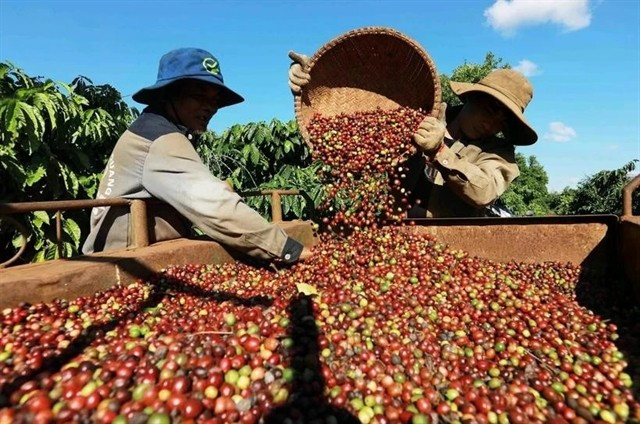
Against this backdrop, Viet Nam’s average export price in the first nine months of 2025 exceeded 5,600 USD per tonne – the highest level ever recorded, up more than 45% year-on-year. This outcome reflects both market factors and structural changes within Viet Nam’s coffee industry itself. Whereas in the past Vietnamese robusta was often viewed as a “low-end” raw material with prices far below arabica, in recent years, as roasters worldwide have adjusted their blends and upgraded the quality of robusta, the status of this variety has been reassessed. With its position as the world’s leading exporter of robusta, Viet Nam has become a central factor in the supply-security strategies of global roasters and coffee chains.
The structure of export markets also shows many positive signs. The European Union remains the largest buyer, accounting for around 40% of Viet Nam’s total coffee export value, with key destinations such as Germany, Italy and Spain maintaining stable demand. In the context of the EVFTA continuing to provide tariff advantages, Vietnamese coffee is in a good position to expand market share, especially in the raw-material segment serving industrial roasters. Alongside the EU, markets such as Japan, the United States, Russia, the Republic of Korea and several Middle Eastern and Eastern European countries have also recorded strong growth, indicating that the market openness of Vietnamese coffee is becoming increasingly diverse, no longer dependent on just a few traditional outlets.
One of the strategic shifts in Viet Nam’s coffee sector in recent years has been the strong move towards exporting processed products with higher value added. For decades, green coffee beans accounted for an overwhelming share of exports, leaving value heavily dependent on world price fluctuations. However, since around 2022, exports of roasted, instant, extract and other processed coffee products have increased consistently at double-digit rates. Export value of processed coffee rose by about 30% in 2023, 35% in 2024 and, notably, by more than 60% in just the first eight months of 2025. These figures clearly reflect the trend of Vietnamese enterprises moving into higher value-added segments, while also highlighting the positive impact of investments in processing technology, improvements in raw-material quality, the development of traceability systems and stronger value-chain linkages with international roasters.
At the farm level, many sustainable coffee production models based on standards such as 4C, Rainforest Alliance and Fairtrade have been rolled out extensively in the Central Highlands. Farmers participating in linkages with roasters and exporters not only receive technical support in cultivation, but also benefit from better purchase prices if they meet requirements on quality, environmental protection and traceability. From a long-term perspective, these models constitute the foundation for Viet Nam’s coffee industry to comply with increasingly stringent regulations in developed markets, particularly the European Union.
Nevertheless, behind the record figures lie several structural challenges. The first is a high degree of dependence on global price movements. While the 2024–2025 period has seen prices at elevated levels, the history of commodity markets shows that agricultural prices are inherently cyclical, with sharp corrections after booms. If supply from Brazil, Colombia and other producers recovers strongly over the next few crop years, world coffee prices could easily retreat to lower ranges. In such a scenario, enterprises and farmers who have simply “followed high prices” without investing in quality, deep processing and brand-building will be the first to suffer.
The second challenge comes from environmental and emissions standards, which are becoming a new class of technical barriers. The EU’s regulation on deforestation-free products, under which coffee is one of the key commodities, requires that products entering the market must be proven not to be associated with deforestation after a specified cut-off date and must be traceable back to specific production plots. Given that Viet Nam’s coffee production is characterised by hundreds of thousands of small, scattered farmers, meeting these requirements will demand major efforts to digitalise plantation data, build traceability systems and reorganise value-chain linkages. If the sector is slow to act, the risk of losing part of the EU market due to non-compliance is entirely real.
A third challenge is the gap in branding. Despite being among the world’s top coffee exporters, Viet Nam still lacks a strong national coffee brand in international consumer markets. Most of the value added at the final stages – roasting, retail and beverage services – remains in the hands of foreign brands. In the context of coffee-growing areas being almost impossible to expand and yields having approached their ceiling, upgrading branding and participating more deeply in processing, distribution and services is the only way to achieve growth based on value rather than volume.
From a strategic perspective, many experts believe Viet Nam is facing a historic opportunity to shift its role from a “raw-material exporter” to a “value leader” on the global coffee map. The foundations for this shift lie in its supply position for robusta at a time of global shortage, the strong growth of processed products and a global consumption trend that increasingly values products with clear origin stories and sustainability credentials. The global market is also providing favourable conditions, as coffee consumption typically rises during the winter and year-end festive seasons, while international prices are likely to remain relatively high in the short term.
To turn short-term opportunities into long-term gains, Viet Nam’s coffee sector needs a clear strategic vision. On the enterprise side, deep processing must be regarded as a priority pillar, with serious investment in roasting, instant, extract and new product lines such as specialty coffee, capsules and ready-to-drink beverages, tailored to specific market segments. Leading enterprises should act as “core integrators”, commissioning raw-material areas with specific requirements on varieties, cultivation practices, environmental standards and traceability, thereby forming “customised” raw-material zones for each target market. On the side of the State and local authorities, standards such as the EU’s deforestation-free regulation should be treated as reference frameworks for restructuring production. This includes rapidly building a national database of coffee-growing areas, issuing criteria for sustainable coffee-production regions and introducing support mechanisms for farmers, cooperatives and enterprises in terms of financing, technical assistance and digital infrastructure.
Trade strategies also need to be adjusted so as to both consolidate core markets such as the EU, the United States and Japan and expand into emerging markets where demand for robusta, instant coffee and convenient coffee products is growing rapidly, such as the Republic of Korea, the Middle East, Eastern Europe and some Latin American countries. Viet Nam’s network of free trade agreements – including the EVFTA, CPTPP, RCEP and UKVFTA – provides an important platform for Vietnamese coffee to reduce tariff costs, improve market access conditions and position itself within broader promotion campaigns for Vietnamese agricultural products and cuisine.
Finally, a more proactive approach to price-risk management is needed. Enterprises and farmers should not simply rely on rising price trends, but should gradually become familiar with and use hedging tools such as forward contracts, long-term contracts with strategic partners and diversification of markets and product portfolios to soften the impact of market swings. At the same time, a sector-level mechanism for market information coordination, linking farmers, enterprises, banks and regulators, would help limit “each to their own” behaviour and strengthen the sector’s resilience to volatility.
Given current results and trends, Viet Nam’s coffee exports in the whole of 2025 are forecast to exceed 1.6 million tonnes and reach around 9 billion USD. This is not only a historic milestone in terms of scale, but more importantly, a signal that Viet Nam’s coffee industry is gradually moving away from a growth model based on volume towards a new phase of development founded on quality, value and sustainability. How Viet Nam uses the “record year” of 2025 to restructure its value chain, strengthen processing capacity, build brands and adapt to new standards will determine whether this is merely a temporary peak in a favourable price cycle, or the starting point for a new, higher position of Vietnamese coffee on the world map.