The News
Despite Tariffs, U.S. Business Delegations “Descend” on Ho Chi Minh City to Buy Vietnamese Goods
Despite ongoing volatility in global trade and a 20% reciprocal tariff, a large number of U.S. companies are still choosing Ho Chi Minh City as a key sourcing destination at Viet Nam International Sourcing 2025 (VIS 2025) from 4–6 September.
According to the Foreign Market Department under the Ministry of Industry and Trade, even as the administration of President Donald Trump imposes a 20% reciprocal tariff on Vietnamese goods, many U.S. enterprises continue to view Ho Chi Minh City as a pivotal meeting point at VIS 2025.
“This is a clear signal that demand for supply chain connectivity with Viet Nam remains strong. U.S. companies are shifting towards directly sourcing from Vietnamese manufacturers to shorten logistics chains, reduce costs and enhance supply autonomy,” a representative of the Foreign Market Department noted.
From the U.S. West Coast, the state of Oregon has confirmed it will send a large delegation led by State Representative Daniel Nguyen, bringing together major players in agriculture, food, technology, outdoor apparel and logistics. Their agenda at VIS 2025 focuses on B2B sessions, aligning technical requirements, quality standards, supply models and conducting on-site factory and industrial zone inspections. Along with a packed working schedule in Hanoi, Da Nang and Ho Chi Minh City, the Oregon delegation aims to establish MOUs and concrete cooperation agreements immediately after the event.
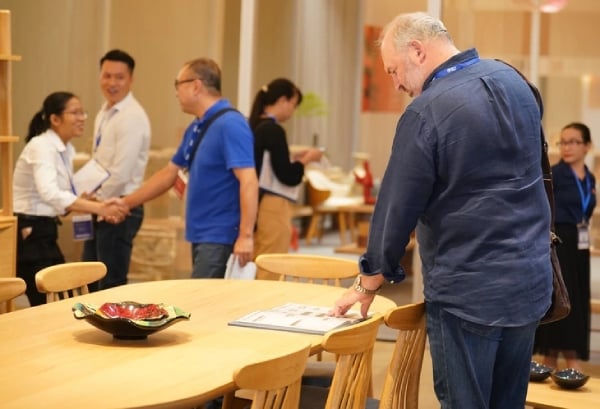
Vietnamese and U.S. businesses connect at the event.
From the South, VIS 2025 is expected to welcome the largest-ever import, distribution and logistics delegation from Texas, including L&V Food Supply, C&T Produce Wholesale, Ca Mau Supermarket, Port Houston, MIB – Morris International Beverage and others. This group is seeking a wide range of “Made in Vietnam” products: electromechanics, machinery, textiles, chemicals and plastics, footwear, food and beverages, handicrafts and furniture. The participation of Port Houston signifies strong interest in optimizing shipping routes and establishing a direct gateway into the U.S. Southern distribution network.
The core priority for U.S. buyers at VIS 2025 is to work directly with Vietnamese suppliers right on the exhibition floor: exchanging catalogues, technical specifications, traceability requirements, ESG compliance, delivery timelines and sustainable sourcing models. With competitive pricing, consistent quality and increasing compliance capability, Vietnamese companies have an opportunity to gain shelf access faster through the distribution systems and logistics networks operated by U.S. firms attending VIS 2025.
Combining U.S. strengths in technology, finance and managerial expertise with Viet Nam’s market potential and skilled workforce, VIS 2025 is expected to serve as a launchpad for strategic trade and investment projects.
From the series of meetings at the exhibition, the Ministry of Industry and Trade expects numerous deals and contracts to be signed, opening a new chapter in deeper, more comprehensive cooperation between Viet Nam and the states of Oregon and Texas in particular, and between Viet Nam and the United States overall.
By the end of 2024, Viet Nam had become the 8th largest trading partner of the United States and its 4th largest export market within ASEAN. Conversely, the U.S. remained Viet Nam’s second-largest trading partner and largest export market.
According to the General Statistics Office, in the first seven months of 2025, the U.S. was Viet Nam’s largest export market, with export turnover reaching USD 85.1 billion. During the same period, Viet Nam’s trade surplus with the U.S. reached USD 74.6 billion, up 28.6% compared with the first seven months of 2024.
Hữu Hưng